
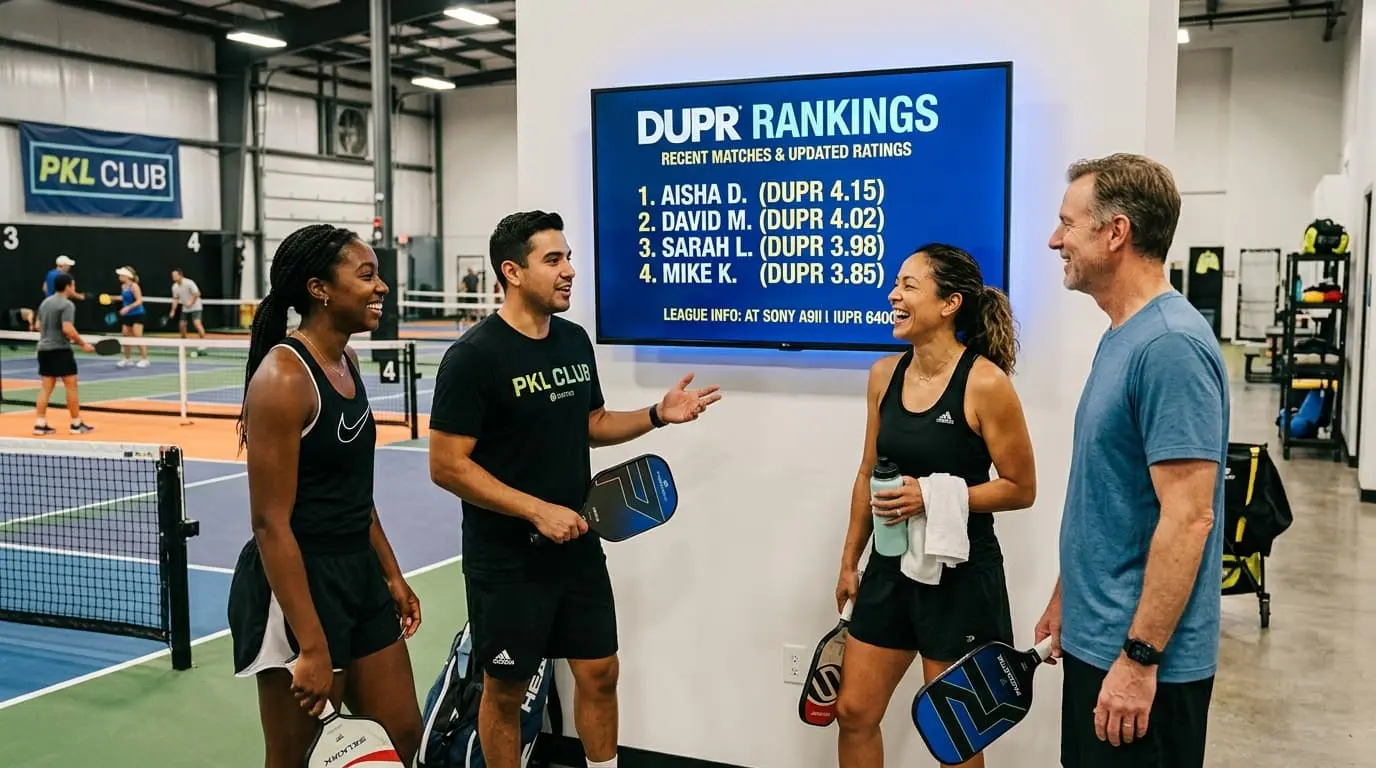
Your DUPR rating is the one number in pickleball that follows you everywhere onto every court, into every tournament bracket, and through every league sign-up form. Whether you’re booking a court at an indoor facility like PickleX in Oakville or registering for your first competitive event, this number quietly shapes who you play against and how you measure your growth.
This guide breaks it all down how the rating works, what the levels mean, practical strategies to climb, and what’s coming next with AI-powered analytics. No jargon overload. Just the stuff that actually matters to you as a player.
What Is DUPR?
DUPR stands for Dynamic Universal Pickleball Rating. It’s a skill-based rating system that evaluates players on a scale from 2.000 (beginner) to 8.000 (professional). Unlike older methods that relied on tournament results alone or a player’s own self-assessment, DUPR pulls data from every type of competitive match tournaments, leagues, club events, and even recreational games.
The “universal” part is key. DUPR doesn’t care about your age, gender, or where you play. A 4.0 in Oakville means the same thing as a 4.0 in Austin, Texas, or Singapore. That global consistency is what’s made it the standard across organizations like the Professional Pickleball Association (PPA), Major League Pickleball (MLP), and over a million rated players worldwide.
How Is Your DUPR Rating Calculated?
DUPR’s algorithm goes well beyond wins and losses. It weighs four key factors:
Match outcome: Did you win or lose? The most obvious input, but only part of the equation.
Score margin: Beating someone 11–1 signals a much bigger skill gap than winning 11–9.
Opponent and partner ratings: Beating a 4.5-rated player carries more weight than beating a 3.0. If you’re paired with a significantly stronger partner, the algorithm accounts for that too.
Reliability score: After roughly 10–20 logged results, your rating becomes significantly more stable and trustworthy.
Your rating updates after every submitted result whether from a tournament platform, a club’s booking system, or a self-posted recreational game through the DUPR app.
What Each DUPR Rating Level Looks Like on Court
| DUPR Range | Skill Level | What It Looks Like on Court |
| 2.000–2.999 | Beginner | Learning basic rules, inconsistent serves and returns, limited court awareness. |
| 3.000–3.499 | Intermediate | Sustains rallies, developing a third-shot drop, starting to understand positioning. |
| 3.500–3.999 | Adv. Intermediate | Consistent dinks and drives, understands stacking, intentional shot selection. |
| 4.000–4.499 | Advanced | Strong soft game, exploits opponent weaknesses, controls pace and placement. |
| 4.500–4.999 | Elite Amateur | Tournament-ready strategy, fast hands at the kitchen, minimal unforced errors. |
| 5.000+ | Pro / Semi-Pro | Competes nationally or internationally with exceptional consistency and power. |
Players develop different skills at different rates your DUPR reflects the overall package.
DUPR vs. UTPR vs. Self-Rating: Which One Should You Trust?
| Feature | DUPR | UTPR | Self-Rating |
| Based On | Match results + algorithm | Tournament results only | Player’s own judgment |
| Includes Rec Play | Yes | No | N/A |
| Updates Dynamically | Yes, after every match | Periodically | Manual |
| Anti-Sandbagging | Yes (Fairplay tools) | Limited | None |
| Global Adoption | PPA, MLP, 1M+ players | USA Pickleball events | Informal / local |
Self-rating is inherently subjective. UTPR only captures tournament data, excluding most recreational players. DUPR bridges that gap by incorporating all competitive play and using an algorithm instead of human judgment.
How to Get Your DUPR Rating
Getting started with DUPR is straightforward. There are two main paths:
Play in a DUPR-connected event. Most major tournaments, leagues, and club platforms sync results directly to DUPR. If your facility uses CourtReserve, Pickleplay, or similar systems, your results may already be feeding into your profile without you doing anything extra.
Get rated by a DUPR Coach. Certified DUPR Coaches can assess your skill level during a structured session a great option if you’re new to competitive play and want a baseline rating before jumping into leagues or tournaments.
Once you have your first result, your profile is live. From there, every match you play and log contributes to a more accurate picture of your skill level.
Can Recreational Games Count Toward Your DUPR?
Yes and this is one of the features that sets DUPR apart. Through the DUPR app, you can self-post recreational match results with your opponents’ consent.
There’s an important nuance: self-posted rec games carry less algorithmic weight than verified tournament or league results. DUPR uses this distinction to maintain accuracy verified events have stricter reporting standards and oversight, so those results get prioritized. But for players who aren’t competing in tournaments regularly, self-posted matches are the primary way to build and track a rating. If you’re playing drop-in sessions or social play at a local facility, logging those games gives you a real number to measure progress against.
What Are DUPR Verified Events?
In 2026, DUPR has been pushing hard toward “Verified Events” tournaments and league matches reviewed and approved by DUPR’s Fairplay Committee. These events carry significantly more weight in the algorithm, come with anti-sandbagging protections, and use standardized score reporting.
Major tours including the Proton National Tour, Minor League Pickleball, and the US Senior Leagues have adopted the Verified standard. For players, this means fairer brackets and more meaningful competition. For organizers, becoming DUPR Verified signals credibility and attracts serious competitors. It’s quickly becoming the benchmark for organized competitive play.
7 Practical Ways to Improve Your DUPR Rating
1. Play against players at or slightly above your level. This gives you the best chance to earn meaningful rating points while being challenged enough to grow.
2. Focus on score margins, not just wins. If you’re up 9–2, push for 11–2 instead of coasting to 11–8. Decisive wins carry more weight.
3. Log your recreational matches. Every rated game feeds the algorithm. More data means a more accurate and potentially higher rating.
4. Invest in coaching. A certified coach can pinpoint weaknesses dragging down your game. Even one or two targeted sessions can yield immediate results.
5. Enter DUPR Verified events. A strong performance in a verified tournament can move your rating more than dozens of self-posted rec games.
6. Choose your doubles partner wisely. Pairing with someone far above or below your rating distorts results. Play with partners near your level for the most accurate reflection.
7. Set SMART goals. Instead of “I want a higher DUPR,” try “I want to raise my DUPR by 0.25 in three months by playing two rated matches per week.” Specificity creates accountability.
Singles vs. Doubles: Does DUPR Rate Them Differently?
Yes. DUPR maintains separate ratings for singles and doubles. The skills that make a dominant singles player court coverage, power, endurance aren’t identical to what makes a great doubles player: soft game, communication, and poaching. If you only play doubles, your singles rating will remain unrated or stale, and vice versa. For players who compete in both formats, this dual-rating system gives an honest snapshot of where you stand in each discipline.
DUPR and AI: The Future of Pickleball Ratings
One of the most exciting 2026 developments is DUPR’s move into AI-powered analytics. Through a partnership with video analysis technology providers, DUPR is exploring “DUPR Vision” an AI system that can analyse match footage to identify performance patterns beyond wins and losses.
Think shot selection tendencies, transition zone efficiency, serve placement consistency, and unforced error patterns. Over time, these video-backed insights could be layered into the rating algorithm itself, creating an even more nuanced understanding of player skill. It’s still early, but it signals where competitive pickleball is heading: a future where your rating reflects not just your results, but how you play the game.
Is DUPR Used in Canada?
Absolutely. DUPR’s adoption across Canada has grown steadily, with clubs, leagues, and tournament organizers increasingly using it for bracket placement, league divisions, and skill-based programming. In the Greater Toronto Area and Southern Ontario specifically, DUPR has become an essential part of the local pickleball ecosystem. Facilities that run organized leagues and tournaments rely on DUPR ratings to ensure fair matchups and competitive integrity which is exactly what players want when they show up to compete.
If you’re playing regularly at an indoor facility in Ontario, chances are your results are already contributing to your DUPR profile through the booking and event platforms these clubs use.
How Facilities Like PickleX Use DUPR for Fairer Play
As a DUPR-certified indoor pickleball facility in Oakville, PickleX uses official ratings to drive competitive programming from league placement and tournament seeding to social play groupings and coaching recommendations. A universal rating system means every player gets matched with opponents who genuinely challenge them, not opponents who make the game frustrating or uncompetitive.
This matters more than most players realize. Nothing kills enthusiasm faster than consistently being overmatched or undermatched. DUPR gives certified facilities like PickleX the data they need to get those groupings right, which keeps players engaged and the community growing.
Whether you’re a 3.0 looking to crack 3.5 territory or a 4.5 competitor eyeing tournament podiums, knowing your DUPR and actively working to improve it gives your pickleball journey real structure and direction.
Frequently Asked Questions
How many games does it take to get an accurate DUPR rating?
DUPR recommends 10–20 match results for a reliable rating. You’ll receive a rating after your first result, but accuracy improves significantly with more data.
What is considered a “good” DUPR rating?
For most recreational players, 3.0–4.0 is solid. Competitive club players typically fall in the 4.0–4.5 range, while 5.0+ is generally elite or semi-professional.
Can I lose my DUPR rating if I stop playing?
Your rating won’t disappear, but DUPR factors in recency. If you haven’t played rated matches in a while, your reliability score may decrease, meaning your next few results will carry more weight as the algorithm re-calibrates.
Does DUPR work for youth and senior players?
Yes. DUPR rates all players on the same 2.0–8.0 scale regardless of age. In 2026, DUPR has expanded into high school, collegiate, and senior leagues (35+, 50+, 60+).
Ready to Put Your DUPR to Work?
Whether you’re brand new to pickleball or chasing your next rating milestone, PickleX in Oakville gives you the courts, coaching, leagues, and community to make it happen. Book a court, join a social play session, or sign up for a league and start building the DUPR rating that reflects the player you’re becoming.
Disclaimer: This blog post is for informational purposes only. DUPR ratings and policies are managed by DUPR Inc. Visit dupr.com for the most up-to-date information on their rating system and events.