
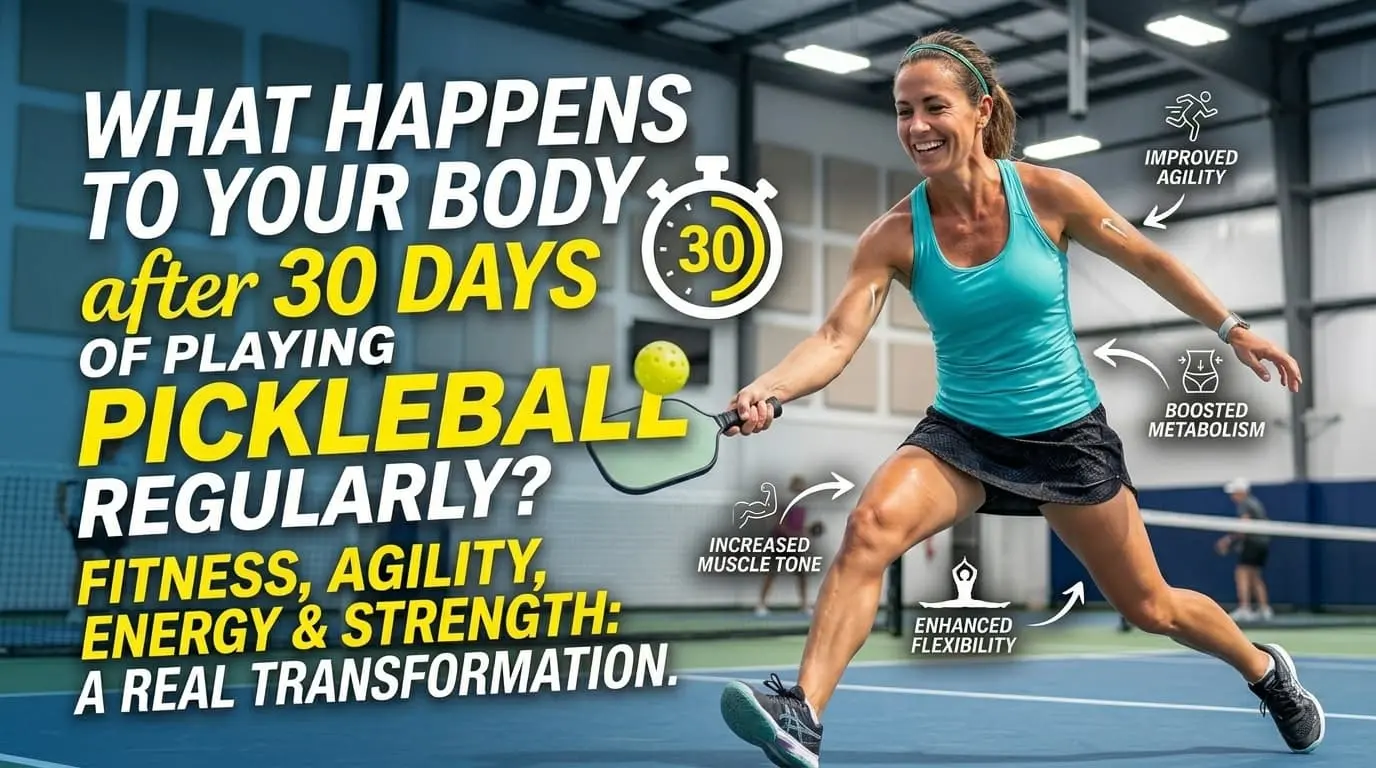
Somewhere around the second week, something shifts. The paddle stops feeling foreign in your hand, your legs stop complaining after every session, and you start noticing things about your own body you hadn’t paid attention to in years reaction time, breath control, the way your knees track when you lunge for a low ball. Thirty days of consistent play is enough time for real, measurable adaptation to begin. Here is what is actually happening beneath the surface.
What Changes in Your Cardiovascular System After a Month?
Pickleball is interval exercise disguised as fun. Rallies spike the heart rate into an aerobic-anaerobic zone, then let it settle during the walk back to the baseline, repeating dozens of times per session. Over 30 days of regular play, most beginners notice measurable cardiovascular gains:
- Lower resting heart rate: The heart pumps more efficiently, often dropping resting rate by several beats per minute.
- Improved oxygen efficiency: Better VO2 max means less fatigue during extended rallies.
- Faster recovery between points: Heart rate returns to baseline more quickly after high-intensity exchanges.
These are the same benefits associated with structured interval-training programs, just delivered through competitive doubles points instead of a treadmill.
How Does Your Balance and Agility Improve?
Pickleball demands constant micro-adjustments split-steps, lateral shuffles, quick pivots toward the non-volley zone. This repetitive lateral movement trains proprioception, the body’s internal sense of position and balance.
- Ankle and knee stability improve as stabilizer muscles strengthen from repeated directional changes.
- Reaction time sharpens as the nervous system adapts to tracking a fast-moving ball at close range.
- Core engagement increases, since most shots require rotational stability rather than arm strength alone.
By week four, many players notice they are recovering their positioning faster after a stretch or lunge a direct sign of improved neuromuscular coordination.
What Happens to Your Muscles and Joints?
The first week typically brings soreness in unfamiliar places: forearms, calves, and the outer hips. That soreness fades as fast-twitch muscle fibers adapt to the sport’s short, explosive movement patterns.
- Forearm and grip strength build from repeated paddle contact and dinking control.
- Glute and quad endurance improve from constant bending and lateral lunging.
- Joint resilience increases, provided proper footwear and warm-up habits are in place, since the sport’s low-impact nature is easier on cartilage while still building supportive muscle around the knees and ankles.
This kind of weight-bearing, joint-friendly movement also supports long-term bone density, which is part of why the sport has found fans across such a wide age range.
Does Regular Play Affect Your Mental Health and Sleep?
The social and competitive elements of the game trigger measurable neurochemical shifts. Endorphin release during exercise helps lower cortisol, the body’s primary stress hormone, while the social nature of doubles play adds a layer of connection that solo workouts rarely provide.
- Stress levels drop noticeably after regular sessions, especially for players who pair movement with social interaction.
- Sleep quality often improves, as physical exertion combined with lowered cortisol supports deeper sleep cycles.
- Mood stabilizes over the course of a month, a pattern consistent with most forms of regular aerobic activity.
How Much Does Skill and Confidence Change in 30 Days?
Physical adaptation isn’t the only shift technical improvement compounds quickly in the first month. Dinking becomes more controlled, third-shot drops land with more consistency, and court awareness develops faster than most beginners expect. You don’t need professional pickleball training to notice the difference; consistent repetition alone starts rewiring the fundamentals of paddle control and positioning. Many players track this early progress through their DUPR rating, watching their reads on pace, spin, and placement sharpen week over week.
Final Thoughts
Thirty days won’t turn a beginner into a tournament competitor, but it’s enough time for the body to fundamentally recalibrate: a stronger heart, sharper balance, more resilient joints, and a calmer mind. The changes are gradual but compounding, which is part of why so many players who start at indoor clubs like PickleX end up sticking around long after that first month is over. The body adapts quietly, one session at a time and by day thirty, you’re simply not the same player who first picked up a paddle.