
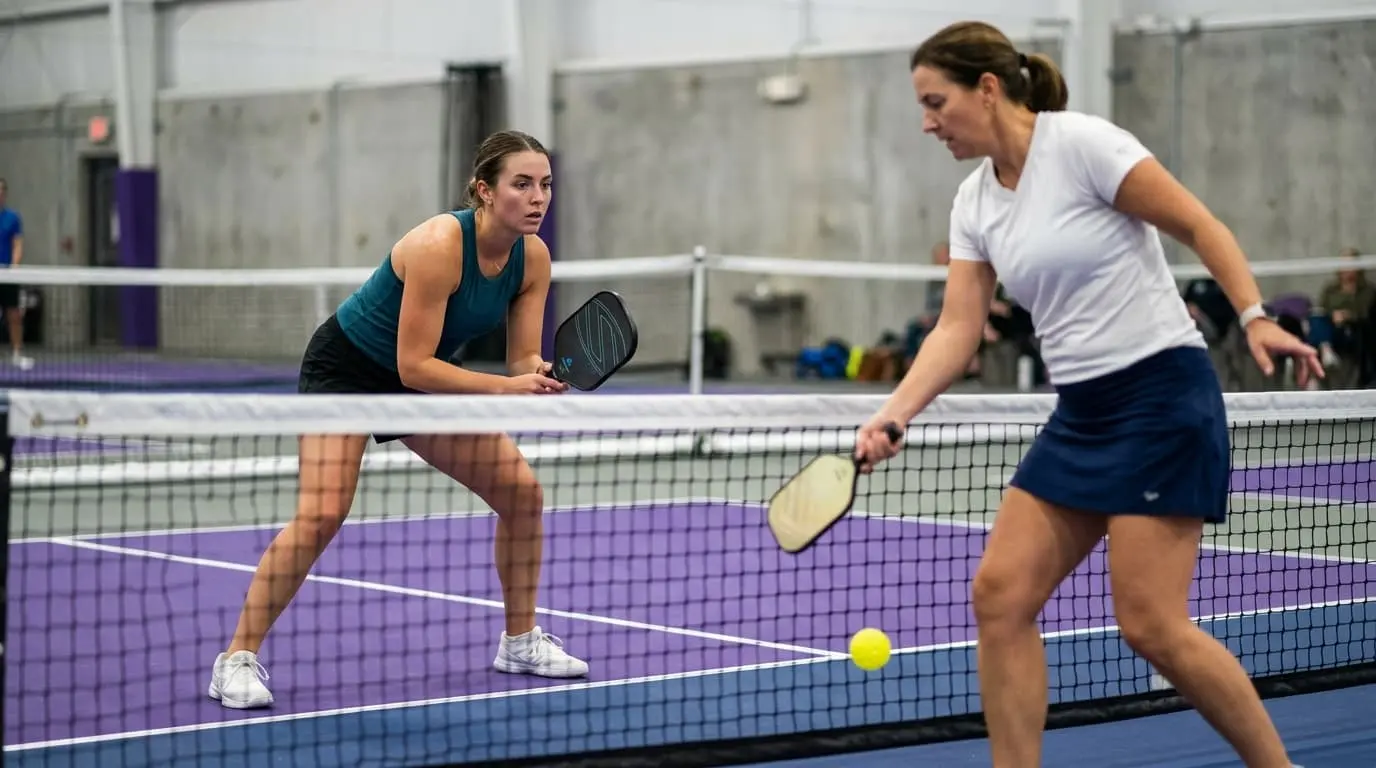
At the kitchen line, a pickleball rally can move faster than the human eye can comfortably track. Reaction alone is not enough by the time the ball leaves an opponent’s paddle, the best players are already moving. The difference is anticipation: the trained ability to decode an opponent’s body, paddle, and positioning a split-second before contact. Reading an opponent is not an innate gift. It is a learnable skill built on pattern recognition, observation discipline, and a small set of reliable visual cues that virtually every player from 3.0 recreational to 5.0+ professional telegraphs without realizing it.
Why Does Reading Your Opponent Matter in Pickleball?
Reading your opponent matters because pickleball at the non-volley line moves faster than pure reaction allows. When all four players are at the kitchen, the ball travels between paddles in roughly 0.3 to 0.5 seconds close to or below average human visual reaction time. Waiting for the ball to leave the opponent’s paddle before moving means you are already late. Anticipation buys an additional half-second of preparation, which is enough to set your paddle, square your feet, and choose a response rather than improvise one. Coaches consistently rank anticipation among the top three traits separating intermediate (3.5) from advanced (4.5+) players, alongside dink consistency and shot selection.
What Are the Main Cues to Watch For?
The most reliable shot tells come from five categories of pre-contact information:
- Paddle position (height and face angle)
- Body alignment (shoulders, hips, feet)
- Backswing length
- Grip pressure
- Weight distribution and balance
Secondary cues eye direction, breathing rhythm, and shot-pattern history add precision once the primary cues become second nature. Reading happens in stacked layers: paddle position narrows the shot type, body alignment narrows the direction, and contextual patterns predict the choice. No single cue is reliable on its own; the combination is what produces genuine anticipation rather than guesswork.
How Does Paddle Position Reveal the Opponent’s Shot?
Paddle position is the single most reliable indicator of an incoming shot. Two elements matter most: height and face angle.
Paddle Height
- High (chest level or above): The opponent is preparing to volley, punch, or speed up the ball. Stay back and protect your body.
- Mid-level: A neutral ready position; the player could go either soft or hard.
- Low (knee level or below): A soft shot is coming a dink, drop, or defensive reset. Move forward.
Paddle Face Angle
- Closed face (tilted down): Expect a drive, roll, or topspin attack. The swing path will travel low-to-high with pace.
- Open face (tilted up): Expect a dink, drop, or lob. The swing path will be soft and under the ball.
Backswing Length
A long, looping backswing almost always signals power. A short, compact preparation signals touch. The rule of thumb among coaches: compact prep means soft, long prep means fast.
What Does Body Language Reveal Before a Shot?
Body alignment tells you direction, while weight distribution tells you intent.
- Shoulders and hips: Players naturally align their hips and shoulders toward their target. A front hip rotating cross-court signals a cross-court shot; squared shoulders usually predict a straight shot, often into the body or down the middle.
- Feet: The front foot is a quiet but reliable signal. A foot pointed down the line predicts a straight shot; a foot angled cross-court predicts a diagonal one.
- Knees and stance: Bent knees and a lowered center of gravity indicate a soft, controlled shot. An upright stance with a raised paddle signals an attack.
- Weight distribution: Weight forward on the front leg means aggression typically a drive, speed-up, or attacking volley. Weight back on the heels suggests defense a reset, block, or lob.
- Contact point: A high contact point produces aggressive shots; a low one produces defensive shots. If the opponent is reaching or off-balance, expect a soft reset rather than an attack.
Can You Read Shots From the Eyes and Grip?
Eyes and grip provide secondary but valuable information. Less experienced players often glance at their intended target before swinging short, repeated looks toward a specific zone of the court telegraph the upcoming shot direction. Advanced players sometimes deploy the opposite tactic, looking one way to hit another, so eye-based reads work best against intermediate competition. A visibly tightened grip whitened knuckles, firmer wrist typically precedes a power shot. A relaxed hand and loose wrist precede touch shots like dinks and drops. Grip changes are subtle but remain consistent across most players who have not deliberately trained to disguise them.
How Do You Spot Patterns in an Opponent’s Game?
Visual cues predict the next shot; patterns predict the next several. Use the first three to five rallies of a match as a scouting window and watch for:
- Serve preference: spin, speed, or placement
- Third-shot tendency: drop or drive
- Backhand avoidance: does the opponent run around the backhand?
- Pressure response: safe shot or low-percentage attempt under stress
- Favorite attack angle: body, sideline, or middle
Once a pattern emerges, the goal is not just to predict it it is to bait it. Top players intentionally feed opponents into their preferred shot, then move early to counter. This is why high-level anticipation can look like mind-reading from the outside; in reality, it is structured preparation built on observed behavior.
How Can You Practice Reading Your Opponent?
Reading opponents improves through deliberate practice, not match volume alone. Effective drills include:
- Predict-out-loud drills: During practice rallies, call out the expected shot type (drive, dink, drop) before the opponent strikes the ball. Track accuracy over time.
- Paddle-watch sessions: For one rally at a time, shift visual focus from the ball to the opponent’s paddle just before contact, then back to the ball.
- Split-step training: Time a small ready-position hop to the opponent’s contact moment. The hop loads the legs and shortens reaction time.
- Video review: Watch recorded matches at 0.5x speed and identify how players position themselves before contact.
Most recreational players never train this skill directly. Even ten focused minutes per session at open play, in clinics, or during structured drill blocks at indoor clubs such as PickleX in the GTA builds the reflex within a few weeks.
Final Thoughts
The ability to read an opponent in pickleball is not a gift. It is an observational discipline applied to a small set of consistent cues. Paddle height and angle reveal shot type, body alignment reveals direction, and patterns reveal intent. Layered together, those reads slow the game down not because the player is moving faster, but because they are arriving earlier. That extra half-second is, more often than not, the difference between defending a rally and finishing it.